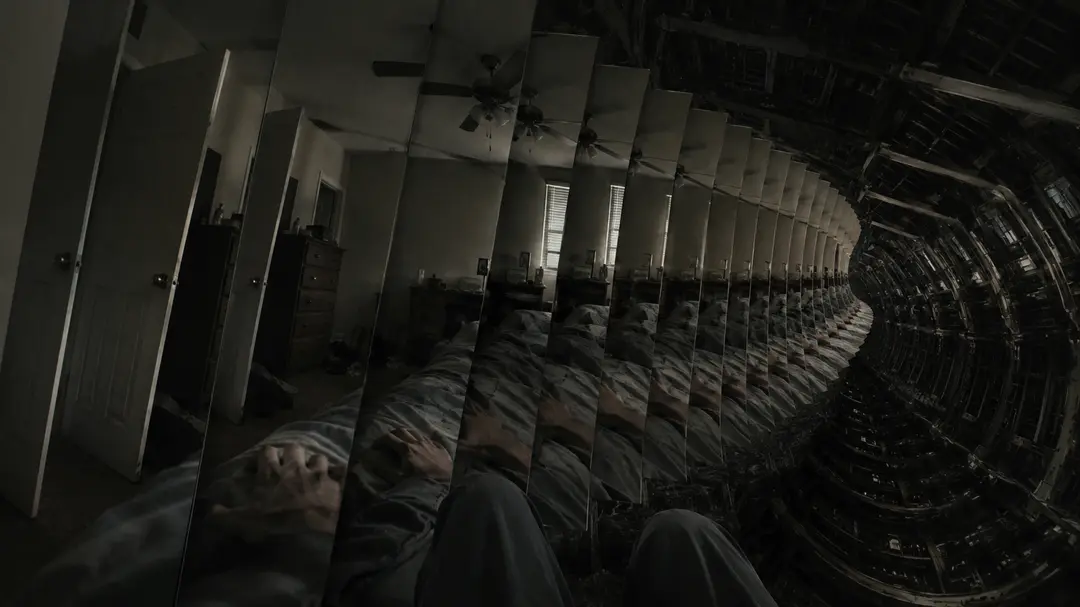
Visual disconnection
Visual disconnection is the experience of becoming distanced and/or detached from one's sense of vision. It is a near-universal effect under the influence of moderate dosages of dissociative compounds, such as ketamine, PCP, and DXM.
Visual disconnection is the experience of becoming distanced and/or detached from one's sense of vision. At its lower levels, this results in visual acuity suppression, double-vision, visual agnosia, and frame rate suppression. This experience can create a wide range of subjective changes to a person's perception of their own vision. These are described and documented in the list below:
- Feeling as if one is watching the world through a screen
- Blurred vision and difficulty perceiving fine details
- Feeling as if the visually perceivable world is further away in distance
- Feeling as if one is looking at the world through someone else's eyes
- Double vision that, at higher levels, forces the user to close one eye if they need to read or perceive fine visual details
Visual disconnection is often accompanied by other coinciding effects, such as cognitive disconnection and physical disconnection. This results in the sensation that one is partially or completely detaching from both their sensory input and their conscious faculties. It is a near-universal effect under the influence of moderate dosages of dissociative compounds, such as ketamine, PCP, and DXM.
At its higher levels, visual disconnection can become all-encompassing in its effects. This results in a complete perceptual disconnection from one's sense of sight, which can be described as the experience of being completely blinded and unable to tell whether the eyes are open or closed due to a total lack of sensory input. During this state, the effect often leads one into the experience of finding themselves floating through a dark and mostly empty hallucinatory void.
Holes, spaces, and voids
Holes, spaces and voids are a sub-component of visual disconnection that manifest when it has become all-encompassing in its intensity. This experience is more commonly known as a "K-hole"12 and is generally discussed as something that is specifically associated with ketamine, despite being present within most traditional dissociatives. A K-hole can be described as the place a person finds themselves in once visual disconnection becomes powerful enough to leave the person incapable of receiving external sensory input, replacing their visual input with a space that subjectively feels as if it is outside of normal reality.
The visual appearance of this space, hole, or void can be described as a vast, mostly empty and darkened chamber that often feels and appears to be infinite in size. This space is usually dark black in its colour, but can occasionally display itself with large patches of slow-moving amorphous colour clouds or subtle geometric patterns across its horizon. At its higher levels, these voids are often populated with hallucinatory structures, which are comprehensively described and documented in the subsection below.
Alongside this visual experience, changes in gravity and a powerful sense of tactile disconnection are also usually present. This can result in one feeling as if they are undergoing an out-of-body experience while weightlessly floating through a void over great distances in a variety of different speeds, directions, and orientations. This is a feeling that is interpreted by many people as floating through space or the night sky.
Structures
Structures are the only feature found within what would otherwise be completely empty and uninhabited voids. These manifest as monolithic 3-dimensional shapes or structures of an infinite variety and size that float above, below, around, or in front of a person as they gradually zoom, rotate, transform, or pan into focus, gradually unveiling before the person's line of sight.
These structures can take the form of any shape, but common examples include vast and giant pillars, columns, tunnels, blocks, buildings, slides, monuments, wheels, pyramids, caves, and a variety of abstract shapes. They are often fractal in shape and can manifest in a variety of colours, but usually follow darker themes and tones with an associated aesthetic that is sometimes subjectively interpreted as "alien" in nature.
Structures can be broken down into the 4 basic levels of complexity and visual intensity described below:
Structures typically display themselves anywhere between 30 seconds to several minutes before the person experiencing them slips back into reality or into the presence of another structure. In terms of how these structures shift between each other, their transition processes can be broken down into 4 basic categories. These are described and documented below:
- Structural transformations - Structures can switch between each other by transforming or shapeshifting in a static and comprehensible way. This is something that usually unfolds in a gradual step-by-step morphing process.
- Structural panning - Structures can switch between each other by remaining completely static in their shape and simply panning out of view until they are no longer within one's field of vision. It’s from here that another structure usually comes into view from outside of one's peripheral vision within a few seconds to a couple of minutes.
- Structural disintegration - Structures can switch between each other by disassembling into many tiny sections that resemble pixels, or building blocks. This occurs in a manner that is reminiscent of smoke or dust blowing in the wind. When forming through this style, the structure will appear to assemble itself step-by-step, becoming increasingly complex as it occurs.
- Traveling over great distances - The third method of transitioning is experienced when the structures appear to be stationary whilst one is floating silently between them over what can feel like extreme physical distances. This floating is sometimes felt to occur on an invisible rail through the vast and infinite dissociative hole."
See also: Dissociative Intensity Scale
Replications
Personal Commentary
Dissociative holes are easily one my favourite deep hallucinogenic states that can be reliably induced. They are a place that I find myself wanting to visit time and time again, particularly under the influence of ketamine or DXM. With holing, as it is more colloquially known, I find myself with a distinct feeling of "coming home" every single time I re-enter this incredibly unique state of consciousness. For me, this is likely due to its accompanying headspace consistently leaving me feeling not just amazed, but extremely tranquil and serene in a manner that equivalent doses of psychedelics rarely come close to.
The K-hole and it's numerous other dissociative induced counterparts are an entirely different world to that of a high dose psychedelic experience. However, despite this state often being overlooked and underestimated by many passionate psychonauts, it is completely equal in its depth. It is absolutely awe inspiring to float, fall, rise, and sink through endless darkened voids and caverns while gazing upon vast everchanging and monolithic structures. Although this place may not be as unfathomably complex as an equivalent psychedelic state, the sheer scale of these hallucinations are truly breathtaking in their own way.
While heavy doses of psychedelics reliably force me to directly confront my problems in a manner that makes it near impossible to use them as an emotional crutch, dissociative substances simply do not do this to nearly the same extent. While I certainly experience deep states of introspection during this state, repeatedly entering it as frequently as I can does not inevitably punish me in the same way that psychedelics would under similar circumstances. In fact, this state of mind feels like a true escape from reality in a manner that has proven irresistibly alluring for me in the past. It is because of this that I would recommend any psychonaut who is burdened with emotional instability and an addictive personality to tread carefully when exploring this state of consciousness with any regularity.
 Josie Kins~2017–2021